

Paper-test 0DTE options without cherry-picking by recording your entry rules, exit rules, and execution assumptions before the session, then keeping every qualifying signal—including losses and skipped trades. Options with zero days to expiration expire that trading day; a simulated win is not proof you could have entered or exited at the recorded quote.
- Paper-test 0dte options with rules recorded before the session, not explanations written after the move.
- Keep losing signals, missed entries, and uncertain fills visible in the same record as wins.
- FlowMonkey provides gamma maps and options-flow alerts for retail index-options traders; those inputs do not validate a strategy.
- Separate changes to your rules from results collected under the original rules.
Why this matters
A chart shows where the market went. It does not prove what you knew beforehand, whether your signal appeared in time, or whether your order would have filled. That gap is where a clean-looking paper record becomes fiction.
For your 2026 testing journal, make the record difficult to rewrite. Save the original plan, preserve timestamps, and put failed reads beside successful ones.
FlowMonkey supplies live gamma maps and options-flow alerts. Those are research inputs, not evidence that a trading rule works. The evidence comes from applying the same rule to qualifying opportunities without deleting the uncomfortable results.
How do you paper-test 0DTE options without cherry-picking wins?
Write the rules before the session, record every qualifying signal, and judge results using the execution assumptions you chose in advance. Keep your original record intact when you change your mind.
Use this sequence for a forward paper test, meaning a simulation recorded as events happen rather than reconstructed afterward.
Signal rules
Define exactly what creates a candidate trade. Name the instrument, the market condition, and the observable event that qualifies. An options-flow alert—a notification about an options transaction—is not a complete entry rule by itself.
Write what invalidates the setup, too. If your explanation requires knowing the eventual session high or low, you have used information unavailable at the decision time. Remove that information from the rule before testing it.
Entry rules
Specify when you would submit an order and which contract qualifies. A contract identifies the option type, strike, and expiration; the strike is the level at which the option gives its holder the right to transact under its terms.
Record the quote available when your entry rule triggers. Do not substitute a later, more attractive quote because the original entry looks awkward. If you cannot establish whether the entry was executable, label it uncertain rather than awarding yourself a fill.
Exit rules
Define the conditions for closing the simulated position before opening it. These might depend on an underlying-market condition, an option-value condition, or a time boundary. Choose rules you can observe and record consistently.
State what happens when exit conditions conflict. Otherwise, hindsight will keep selecting whichever exit makes the result look better. A rule that changes during a trade belongs in a separate discretionary record, not silently inside the original test.
Execution rules
Decide how you will handle the bid, ask, and uncertain fills. The bid is a displayed buying quote; the ask is a displayed selling quote. Their difference is the spread.
A quote at the midpoint is not proof that your order would execute there. Include applicable transaction costs when evaluating results, without assuming paper-platform fills match live execution. Mark missing or stale quotes as limitations instead of replacing them with favorable assumptions.
Record rules
Log every qualifying signal, whether you act on it or not. Separate executed simulations, missed entries, rule violations, and genuinely invalid setups. A missed trade does not become a winner simply because the chart later moves in the expected direction.
Keep the original entry and exit notes alongside later comments. When your rules change, start a new version. Different rules produce a different test. Do not merge them into a cleaner-looking history.
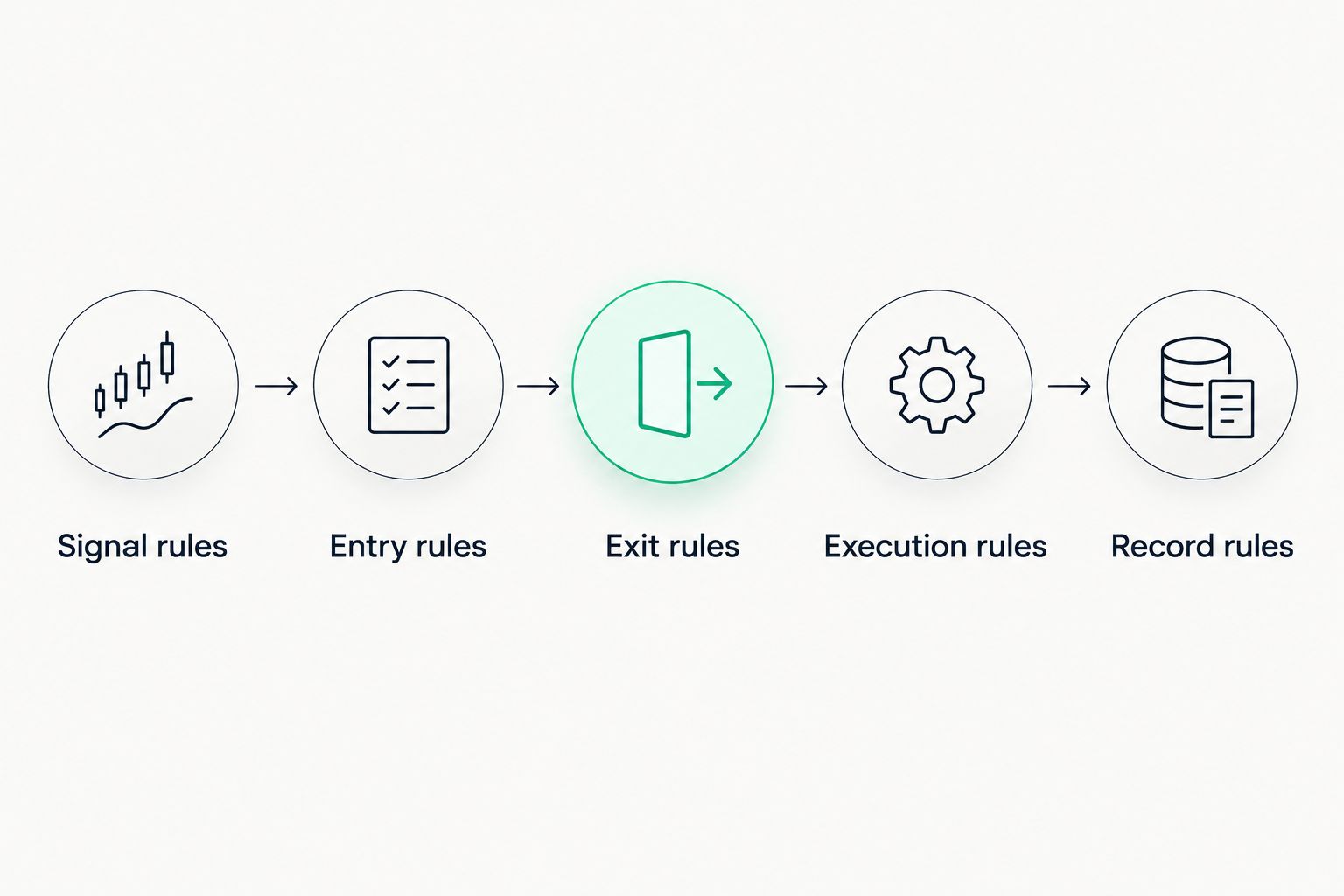
A 2026 journal should preserve both the initial decision and the later outcome. The purpose is not to make the process complicated. It is to stop the outcome from rewriting the decision.
Compare a chart review with a forward paper test
Reviewing historical charts and recording a forward simulation answer different questions. Neither deserves credit for evidence it does not contain.
| Approach | Best for | Useful evidence | Main limitation |
|---|---|---|---|
| Historical chart review | Finding ideas worth testing | Recurring market patterns and possible rule definitions | Later price action is already visible, inviting hindsight |
| Forward paper test | Checking whether you can apply predefined rules | Timestamped signals, decisions, and simulated outcomes | Simulated execution does not establish live fills |
Historical review helps you formulate a question. Forward testing checks whether you can follow the proposed answer without knowing the ending. Neither establishes that future trades will be profitable.
Keep the distinction explicit in your 2026 notes. A screenshot selected after a strong move belongs under research, not under independently recorded test results.
What should you record about gamma and options flow?
Gamma describes how an option's sensitivity to its underlying changes as the underlying moves. Gamma exposure, often shortened to GEX, estimates that sensitivity across options positions under a model's assumptions. It is a model-based view of positioning, not a direct instruction to buy or sell.
A gamma flip is the level where a model's estimated net gamma exposure changes sign. A call wall is a level a provider identifies as a concentration of call-related positioning; the exact calculation depends on the methodology. Neither label guarantees that the market will reverse or stop there.
Record the map's timestamp and the level visible when you made the decision. Do not replace it with the closing map after the session. Also record the instrument: SPY, SPX, QQQ, and IWM are not interchangeable labels for the same underlying.
Options flow describes observed options transactions. A large transaction does not, by itself, reveal a trader's full position or intent. Before treating an alert as a signal, use the same questions covered in checking an options-flow scanner for misleading alerts.
The map supplies context. Your written rule supplies the decision. If the rule requires information the map does not provide, mark the condition unresolved rather than filling the gap with a story.
Why do 0DTE paper-test results vary?
Zero-day options expire on the trading day you are observing. Their remaining time is short, and the option's value depends on more than the direction of the underlying market. That makes execution assumptions and contract selection part of the test, not administrative details.
Separate these drivers in your review:
- Contract selection: Calls and puts, different strikes, and different underlying instruments create different exposures. Record the actual contract rather than just the ticker.
- Time remaining: A morning observation and a near-expiration observation have different amounts of time left. Keep the decision timestamp.
- Implied volatility: This is the volatility assumption reflected in option valuations. Changes can affect option value even when the underlying barely moves.
- Execution assumptions: Spread, available quotes, and transaction costs separate an attractive chart from an executable trade.
- Data timing: A level or alert must have been available before the decision to count as an input.
- Rule changes: Moving an exit after seeing the outcome changes the method. Keep that result separate from the original version.
Your 2026 summary should distinguish a weak signal from a weak simulation. If the fill cannot be established, the result cannot settle whether the trading idea worked.
What does an honest hypothetical paper trade look like?
Hypothetical example—not a real trade or measured outcome: Before the session, you define a setup that requires the underlying to cross a recorded gamma-related level and then meet a separate confirmation condition. You specify the eligible contract and the exit rule in advance.
The underlying crosses the level, but confirmation never appears. You record an invalid setup, even if the market later rallies. Calling it a missed winner would credit a trade your rules never authorized.
On another qualifying observation, confirmation appears, but the available quote is too uncertain to establish a simulated fill. You keep the signal and mark execution unresolved. You do not borrow a later quote to manufacture a clean entry.
Finally, suppose a valid simulated entry reaches its predefined exit condition. You record that exit even if waiting would have produced a better result. The test asks whether your rules work as written, not whether you can find a better ending afterward.
How do you review losses without changing the rules mid-test?
Start with process, then examine outcomes. Did the setup qualify? Was the input available in time? Did the recorded entry and exit follow the original rules?
Keep a losing, rule-following simulation distinct from a rule violation. The former tells you something about the tested approach. The latter tells you that the approach was not followed. Combining them hides both problems.
Use a separate research note for proposed improvements. Describe the change and test it prospectively under a new version. Do not apply the improved rule only to past losers while leaving past winners untouched.
Show the misses first. Put failed signals, unresolved fills, and invalidated ideas where you will see them before the winning screenshots. Public accountability means making those failures inspectable, not merely claiming transparency.
Where does FlowMonkey fit into the test?
FlowMonkey is for retail index-options traders who want gamma maps and options-flow alerts together. Its subscription terminal provides live SPY, SPX, QQQ, and IWM gamma maps and real-time options-flow alerts. Those capabilities help supply observations for your journal; they do not replace your entry rules or establish executable fills.
For a beginner, the useful question is whether you can explain the read in plain English before acting. A colored level without a written condition leaves too much room to reinterpret the chart later. Your journal must also keep misses visible, regardless of which terminal supplies the data.
Use the 7-day trial to assess that workflow, not to declare a strategy profitable. During your 2026 evaluation, check whether you can identify the relevant input, timestamp the decision, explain invalidation, and preserve the failed reads.
Evaluate the workflow before trading
Use the 7-day trial to assess gamma maps and flow alerts against your written paper-test rules.
FAQ
What does 0DTE mean in options trading?
0DTE means zero days to expiration: the option expires that trading day. It describes time remaining, not a standalone trading strategy.
Can paper trading prove a 0DTE strategy is profitable?
Paper trading cannot prove future profitability or establish live execution. It can document whether predefined rules produced simulated outcomes under stated assumptions.
Should I count a trade I noticed only after the move?
Do not count a trade noticed after the move as a forward-tested result. Keep it as a research observation and test the proposed rule on later opportunities.
Can a gamma flip guarantee an entry or reversal?
A gamma flip cannot guarantee an entry or reversal. It marks a change in the sign of estimated gamma exposure under a particular model, not a promised market response.
What should I do when a paper fill looks unrealistic?
Mark an unrealistic or unverifiable paper fill as uncertain rather than accepting it as evidence. Preserve the observed quote and explain which execution assumption failed.
Is FlowMonkey a substitute for a paper-trading journal?
FlowMonkey supplies gamma maps and options-flow alerts, not a substitute for your written test record. You still need predefined rules, decision timestamps, execution assumptions, and visible misses.
One last thing
A correct decision can end in a loss, and a broken rule can end in a win. Your paper test must preserve that distinction. Otherwise, a lucky outcome becomes permission to repeat a bad process.
Before opening the next chart, write what would make you reject the setup. That small step gives the losing evidence a place to land before you are tempted to explain it away.