

Yes. 0DTE options—options with 0 days remaining until expiration—can lose value even when the market barely moves, because their remaining time value can shrink while the underlying price stays flat. A drop in expected volatility can also reduce their value, and a small move in your favor does not necessarily offset either effect.
- 0DTE options can lose value in a flat market because time value disappears as expiration approaches.
- SPY calls and puts both face time decay; buying direction correctly does not guarantee a profitable trade.
- Gamma exposure adds market context, not protection against option losses.
- Check the strike, expiration, spread, and exit plan before buying same-day options.
Can 0DTE options lose value when the market barely moves?
Yes. An option's value depends on more than the direction of the underlying asset—the stock, fund, or index its contract references. The expiration clock keeps running even when that asset barely moves.
FlowMonkey provides gamma maps and options-flow alerts, but market context does not remove this contract-level risk. Start with what you own, then consider what the wider market is doing.
For a purchased option, separate the moving parts:
- Intrinsic value: The amount the option is already in the money, meaning its strike is favorable relative to the underlying price.
- Time value: The additional value associated with the possibility of a favorable move before expiration.
- Market conditions: Expected volatility and trading spreads influence what buyers will pay before expiration.
The strike is the contract's fixed exercise price. As expiration approaches, an option without intrinsic value has less remaining opportunity to acquire it. A quiet market is not a pause button for an expiring option.
Why this matters
A beginner's mistake is to treat an option like a smaller purchase of the underlying asset. The reasoning sounds sensible: if the market stays roughly where it was, the position should stay roughly where it was too.
That reasoning misses the deadline. A same-day option is a contract with rapidly diminishing time remaining, not an indefinite claim on a future market move.
For your 2026 trading checklist, separate two questions: did the market move as expected, and did the option gain value? Those questions can have different answers. Getting the direction right is only part of understanding a purchased option's result.
Long calls: an upward move is not enough by itself
A call gives its holder the right to buy the underlying at the strike, subject to the contract's settlement terms. A long call means you bought that call rather than sold it.
A rising underlying generally helps a long call, with other factors unchanged. But other factors do change. Time passes, expected volatility shifts, and the market's buying and selling quotes move.
Hypothetical example: the market rises slightly
You buy a call that expires today. The underlying edges higher, but the call remains out of the money—its strike is still above the underlying price.
The favorable move helps. The shrinking time remaining hurts. If the lost time value and other adverse changes outweigh the benefit of the rise, the call loses value anyway.
The lesson: a correct directional call does not guarantee a profitable options purchase. This example describes a possible outcome, not an actual trade or a measured result.
Long puts: a small decline can still produce a loss
A put gives its holder the right to sell the underlying at the strike, subject to the contract's settlement terms. A long put means you bought that put.
A falling underlying generally helps a long put, with other factors unchanged. The same expiration clock applies, however, and a modest decline does not automatically overcome lost time value.
Hypothetical example: the market drifts lower
You buy a put that expires today. The underlying falls slightly but remains above the put's strike, leaving the put out of the money.
The decline moves the market in your preferred direction. Yet the remaining opportunity for a larger decline is disappearing. The put can lose value despite the move lower.
The table compares purchased calls and puts, not recommendations to trade either:
| Purchased option | Direction that generally helps | What a flat market leaves exposed | Main limitation |
|---|---|---|---|
| Long call | Rising underlying | Remaining time value | A small rise can fail to offset decay |
| Long put | Falling underlying | Remaining time value | A small decline can fail to offset decay |
Neither position is protected simply because your market forecast sounds reasonable. The contract must respond favorably enough while you still hold it.
Why 0DTE option value varies
These factors explain why similar-looking trades can behave differently. Use them to examine a contract, not to manufacture a precise forecast.
- Time remaining: A contract early in its expiration session has more time for a favorable move than the same contract near its trading cutoff. Theta describes how an option's theoretical value changes as time passes, with other inputs held constant.
- Distance from the strike: An option far from becoming in the money faces a different situation from one trading near its strike. The underlying's location matters alongside its direction.
- Expected volatility: Implied volatility is the level of expected price movement reflected in option prices. A decline can reduce an option's time value even when the underlying barely moves.
- Sensitivity to movement: Delta describes how much an option's theoretical value changes for a small move in the underlying. Gamma describes how that delta changes as the underlying moves.
- Trading friction: The bid is what buyers currently offer; the ask is what sellers currently request. Their difference, the bid-ask spread, can create a loss between buying and immediately selling, even without a meaningful market move.
Theta is not a fixed invoice charged at a constant rate. Its estimate changes with the contract and market conditions. Do not turn a displayed sensitivity into a promise about the next part of the session.
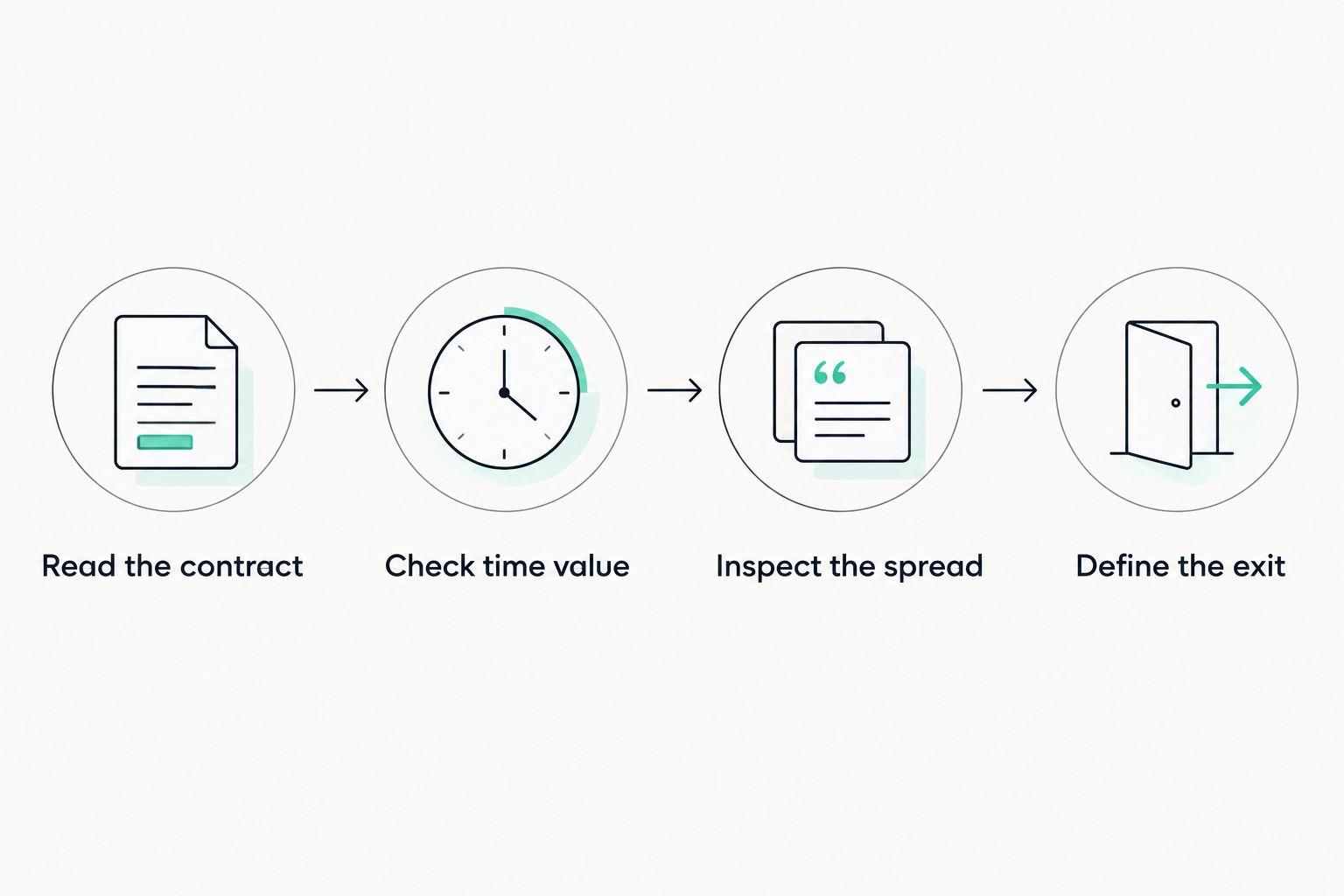
How to check a same-day option before buying
Use this sequence in 2026 before interpreting an alert or choosing a contract. It separates a market observation from an actual trading decision.
Read the contract
Confirm the underlying, call or put, strike, expiration, and settlement method. Do not assume two contracts behave alike because both reference a familiar market.
Standard, unadjusted U.S. equity and ETF option contracts generally represent 100 shares per contract. Index options use different settlement arrangements. That distinction matters when expiration creates an obligation or a settlement amount.
Check time value
Ask whether the option is in the money or out of the money. Then distinguish any intrinsic value from the additional value associated with time and uncertainty.
An in-the-money option can still lose time value. An out-of-the-money option has no intrinsic value to retain if it remains out of the money at expiration.
Inspect the spread
Look at both the bid and ask, not just the last reported trade. A previous trade does not establish what you can receive when you sell now.
A displayed midpoint—the value halfway between the bid and ask—is not a guaranteed execution. Check whether your intended entry and exit depend on fills the market has not offered.
Define the exit
Decide what would invalidate your reasoning before entering. Include the possibility that the underlying stays flat rather than moving sharply against you.
Also check your broker's expiration procedures. An intended short holding period does not remove the need to understand what happens if the position remains open.
Can a gamma map tell you whether an option will hold its value?
No. A gamma map does not forecast the resale value of your specific contract. It supplies a different kind of information.
Gamma exposure, often shortened to GEX, estimates how options positions create exposure to changes in delta. Traders use it to examine potential hedging pressure—buying or selling used to offset risk. Those estimates depend on the positions and assumptions used in the calculation.
A gamma flip is an estimated underlying-price level where aggregate gamma exposure changes sign. A call wall is a label used for a strike with a concentration of call-related positioning or exposure; definitions vary between providers.
Neither is a barrier the market must respect. A market can remain near a highlighted level while your purchased option loses time value.
For a 2026 gamma-map workflow, keep the distinction clear: market positioning describes context; your strike, expiration, and execution determine the contract you actually hold. A colored level does not settle that second question.
What does an options-flow alert actually tell you?
Options flow is the stream of reported options trades. An alert draws attention to activity that meets a provider's criteria, such as a large transaction or unusual activity.
The trade itself does not reveal the trader's complete portfolio or purpose. A call purchase can belong to a larger position rather than a simple bet that the market will rise.
That is why copying a large print—a reported trade—does not give you the original trader's full decision. You still need to understand your own contract, entry, and exit.
An alert is a reason to investigate, not a substitute for understanding the position. A busy options tape does not switch off time decay.
Where FlowMonkey fits for a beginner
FlowMonkey suits retail index-options traders who want gamma maps and options-flow context explained in plain English. Its terminal covers live SPY, SPX, QQQ, and IWM gamma maps alongside real-time options-flow alerts.
The benefit is access to positioning and transaction context. The limitation is equally important: neither tells you that a particular purchased option will retain value, and neither guarantees a market move.
When evaluating FlowMonkey in 2026, judge the explanation as well as the display. Can you explain the read—the interpretation of the data—in your own words? Examine the publicly shown misses, not just examples where the interpretation worked.
Use the 7-day trial to assess whether that process improves your understanding. A useful trial result is knowing what the information means and where it stops—not feeling pressure to place more trades.
Explore the explanation before trading
Review gamma maps and options-flow context. Understand the limits before acting on an alert.
FAQ
Can 0DTE options lose money if the market stays flat?
Yes. Purchased 0DTE options can lose value in a flat market because their remaining time value shrinks as expiration approaches. Changes in implied volatility and trading spreads can also affect your result.
What does 0DTE mean in options trading?
0DTE means 0 days remaining until an option expires. The contract still has a strike, settlement terms, and trading rules that you need to understand before buying.
Can I lose money on a call even if the market goes up?
Yes. A small rise in the underlying can fail to offset lost time value, falling implied volatility, or trading friction. Direction alone does not determine the result of a purchased call.
Do in-the-money options still lose time value?
Yes. An in-the-money option can have both intrinsic value and remaining time value. Losing time value does not mean its intrinsic value has disappeared, although that component also changes with the underlying.
Does a call wall guarantee that the market will stop rising?
No. A call wall describes a concentration of call-related positioning or exposure under a provider's methodology. It is not a guaranteed ceiling or protection against losses.
Does one SPY option represent one share?
No. A standard, unadjusted SPY option generally represents 100 shares per contract. Confirm the contract specifications rather than assuming the same arrangement applies to index options.
Should a beginner use FlowMonkey alerts as automatic trade signals?
No. FlowMonkey alerts provide options-flow context, not automatic instructions to buy or sell. For your 2026 learning process, explain the contract risk and your exit before acting on an alert.
One last thing
A flat-market session can expose a weak trade thesis without any dramatic price move. If your entire reason for holding is that the market has not moved against you, the expiration clock is the missing part of the argument.
Before buying, finish this sentence in plain English: the underlying needs to do something favorable before this contract's remaining opportunity disappears. If you cannot explain what that means for the contract, keep learning before putting money behind it.
Options involve risk. A purchased option can lose the entire amount paid, and exercise or settlement can create consequences beyond watching its quoted value.